Internet Computer (ICP)
互联网计算机是一个区块链网络,允许在安全和去中心化的协议上创建基于网络的服务器。互联网计算机由互联网计算机协议 (ICP) 代币驱动,该代币以前称为 DFN,它使用户能够以更广泛的形式重新创建网络和驱动应用程序,支付区块链上的交易费用(作为交易的燃料),奖励参与者或数据中心,并做出治理决策,持有者可以对网络的未来进行投票。ICP 代币是一种实用代币,在互联网计算机网络中起着关键作用。 [8] [9] [3]
比较加密资产
选择一个资产,与 Internet Computer (ICP) 比较价格和其他数据。
历史
2016年初,互联网计算机的想法由DFINITY的首席科学家兼创始人Dominic Williams提出。DFINITY是一家非营利性数字基金会,在正式启动互联网计算机项目之前,开发并维护了该项目5年。[5] [6] 直到2018年,Dfinity进行了多轮融资,从Andreessen Horowitz、Polychain Capital、Aspect Ventures等贡献者那里筹集了约1.21亿美元[16],包括在网络代币分发之前于2017年进行的首次代币发行 (ICO)。价值约3500万美元的代币于2018年通过空投发布[13]。
到2019年,代币的全面开发开始,Copper发布,ICP于2021年5月上线。它实现了区块链奇点的实现。这是一个能够将网络从主机到存储和服务运行的区块链,在安全的协议中拥有一切,而没有第三方的干扰。与以太坊类似,ICP允许在其网络中启动去中心化应用程序 (DApps),但使用ICP网络中智能合约(如以太坊等区块链中存在的)的升级版本,称为Canisters。[14]
据创始人称,互联网计算机协议 (ICP) 代币象征着继比特币和以太坊之后区块链技术的第三大创新。 这种创新被认为是将互联网发展到下一个重大事件的创新。
“互联网计算机的出现是为了结束大型科技公司的垄断,并用更加去中心化的世界网络取代过度流通的云服务系统,并着眼于成为互联网的延伸” - Dominic Williams
概述
互联网计算机 (ICP) 由 Dfinity 基金会于 2021 年推出,该基金会由 Dominic Williams 创立。该网络旨在允许所有开发者、企业和企业主在“开放互联网”上构建和部署软件。创建者计划替换和改进私有互联网基础设施,使其无需完全依赖安全平台和现有技术。因此,主要思想是拥有一个由区块链技术驱动的去中心化全球网络,该网络的速度足够快,可以支持和运行整个网络的基础层,包括 Web 3 和 DeFi 应用程序。 [12]
互联网计算机基于一种称为链密钥技术的技术运行,该技术由其他系统组成,即网络神经系统 (NNS)、互联网身份和阈值中继共识等。成千上万个节点运行以保护网络,这些节点在分组时形成子网。这些子网具有 权益证明 (PoS) 机制,因此质押的代币越多,奖励就越多。 [11]
网络神经系统 (NNS)
互联网计算机由 NNS 治理,它是世界上最大的 DAO 之一。 作为一个完全链上、无需许可的系统,它通过 ICP 代币持有者的投票,促进互联网计算机的持续升级。 [19]
质押
NNS允许用户通过质押 ICP治理代币来创建投票神经元,这是一种社区通过算法表达集体意志的机制。神经元充当账户,需要提款通知,解散延迟配置决定了通知期限。神经元的投票权和对投票奖励的相对索取权由质押的ICP数量、解散延迟和年龄决定。神经元可以手动投票,也可以通过跟随其他神经元自动投票,从而实现流动民主。NNS中的提案通过由社区成员创建的神经元(质押ICP代币)参与的投票过程来决定。代币持有者通过将质押的ICP代币锁定在这些神经元中来获得奖励,这些神经元在提款前有一个固定的通知期。神经元所有者可以将解散延迟配置为最多8年,但神经元必须至少有6个月的解散延迟才有资格进行投票。 [20][25]
神经元持有者参与一种加密经济游戏,激励他们投票支持或反对提案,或者配置神经元跟随以自动投票,从而推动互联网计算机网络的长期价值。 [20]
代币经济学
互联网计算机网络涉及两种原生代币,包括:
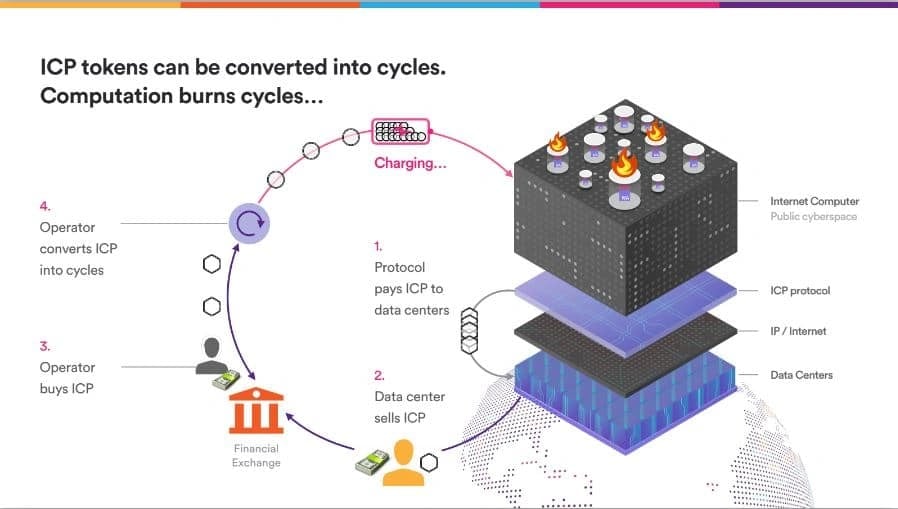
ICP代币可以锁定在网络神经系统(NNS)中,这是一个运行网络的算法协议系统。它们也可以转换为cycles,作为使用容器进行计算的gas费。这个过程涉及燃烧ICP代币以转换为Cycles进行计算,因此被称为通货紧缩。
ICP 功能
ICP 代币有助于互联网计算机 区块链 的运行,以下概述了其核心用例。 [22]
- 节点提供商奖励:互联网计算机 区块链 上的 节点 提供商因提供计算/存储基础设施而获得 ICP 奖励。每月固定奖励以法定货币计算,并以 ICP 代币支付,从而确保运行节点的成本恒定。奖励根据地理位置略有不同,以鼓励更广泛的节点分布。只要节点提供商保持适当的服务质量,他们就会获得奖励,并且奖励通过铸造新的 ICP 代币来支付,从而导致通货膨胀。
- 治理:ICP 代币持有者可以通过 质押(锁定)他们的代币来创建神经元。神经元使代币持有者能够通过网络神经系统 (NNS)(一种链上开放治理系统)来确保投票权。NNS 允许神经元持有者对与升级 IC 协议和软件、加入新的 节点 提供商、添加节点机器以及创建新的子网 区块链 相关的提案进行投票。神经元可以关注其他神经元以委托投票权,并且持有者因通过投票过程参与治理而获得奖励。这些奖励通过 铸造 新的 ICP 代币来支付,从而导致通货膨胀。
- 计算/存储燃料:互联网计算机 区块链 上的 Canister 智能合约 计算由“周期”提供支持,这些周期通过燃烧 ICP 代币获得,类似于 以太坊 上的“gas”。但是,与以太坊的“用户付费”模型不同,互联网计算机使用“智能合约付费”或“反向 gas”模型,其中 Canister 智能合约预先充值周期,使其能够支付自己的计算费用。这使用户无需为每笔交易支付 gas 费用。 燃烧 ICP 实用代币 会产生周期,从而导致通货紧缩。
- 交易/提案费用:ICP 持有者在 钱包 之间转移代币时,以及向 NNS 提交提案时,会被收取少量 ICP 交易费。这些费用作为交易的一部分被 销毁,从而导致通货紧缩。
ICP 燃烧周期分析
BTC<>ICP 主网集成
比特币与互联网计算机的集成将比特币的流动性与互联网计算机的智能合约能力相结合。在主网上启动后,此次集成将为比特币提供先进的智能合约功能。通过这项发展,互联网计算机可以作为比特币的第二层平台,使互联网计算机上的智能合约能够原生持有、发送和接收比特币,而无需区块链桥或第三方等中介。 [23]
Internet Computer Footprint
互联网计算机(IC)生态系统最近实施了NNS提案#55487,这是一项由社区编写的提案,旨在为区块链建立可持续性政策和碳足迹。因此,Carbon Crowd团队启动了互联网计算机足迹项目,该项目旨在减少互联网计算机底层数字基础设施的碳足迹。 [24]
资金
该项目获得了包括 Andreessen Horowitz、Polychain Capital、SV Angel、Aspect Ventures、Electric Capital、ZeroEx、Scalar Capital 和 Multicoin Capital 在内的多个贡献者的财务支持,总计筹集了 1.21 亿美元。DFINITY 基金会在 2018 年向超过 50,000 名注册参与者进行了 空投 ICP 代币。 [21]
2020 年 12 月 18 日,DFINITY 推出了互联网计算机的 alpha 主网,并于 2021 年 5 月 10 日将其公开。因此,互联网计算机的源代码被发布,ICP 实用代币 的交易和治理功能也被引入。 [21]
近期发展
ckBTC 与 Cosmos 的集成
2024 年 9 月,Internet Computer 区块链 与 Cosmos 生态系统之间建立了跨链连接。此项开发涉及 ckBTC,这是一种在 Internet Computer 上发行的、由 比特币 支持的代币,以及 去中心化交易所 Osmosis。该集成由 Omnity 提供支持,Omnity 是一种旨在实现不同区块链网络之间通信的互操作性协议。
该集成使 ckBTC 能够通过 Osmosis 转移到 Cosmos 生态系统中。与依赖托管人或合成表示的传统桥接机制不同,此实现使用 Internet Computer 上的 智能合约(称为罐子)来验证跨链交易。Omnity 通过验证跨网络的共识状态来实现这一点,而无需集中式基础设施。
作为此安排的一部分,Osmosis 成为 Cosmos 生态系统中第一个在其列表中包含 ckBTC 的 去中心化交易所。这允许该资产在平台上进行交易并包含在 流动性池 中。该集成将 ckBTC 的运营范围扩展到其原始网络之外,使其能够与利用区块链间通信 (IBC) 协议的 去中心化应用程序 和协议进行交互。
桥接过程利用 Internet Computer 的原生 比特币 集成与 智能合约 自动化相结合,支持无需中介的资产转移。此配置反映了连接 区块链 环境同时保持去中心化原则的更广泛努力。 [29] [30] [31]
柬埔寨合作与智慧城市协作
2024年9月,DFINITY基金会与柬埔寨邮电部(MPTC)签署了一份谅解备忘录(MoU)。该协议概述了一个合作框架,旨在支持将区块链和人工智能技术整合到柬埔寨的数字基础设施建设中。
合作内容包括计划创建一个国家区块链中心,暂定名为“柬埔寨区块链中心”。该设施旨在作为一个开发和培训环境,开展软件开发研讨会、教育项目以及去中心化技术的合作研究等活动。
其中一个既定目标是在公共部门环境中实施区块链系统,包括身份验证机制、数字服务交付和行政互操作性。互联网计算机(ICP)协议将用作实验和系统部署的基础层。
合作还包括探索人工智能应用,特别是部署在链上运行的自主代理。该计划的其他组成部分包括以社区为中心的活动,如黑客马拉松和能力建设活动,旨在提高该地区的技术参与度。
这项合作代表了一个国家政府与DFINITY基金会之间的正式合作,旨在调查去中心化技术在治理和城市规划中的用例。 [32] [33] [34]
与Elliptic的合作
2025年2月,DFINITY基金会与Elliptic(一家专门从事加密资产合规和风险监控的公司)建立了合作伙伴关系。此次合作的目标是扩展整个互联网计算机生态系统的安全和合规基础设施。通过此次整合,ICP被添加到Elliptic的监控套件中,从而能够跟踪和监管筛选交易。该合作伙伴关系为机构参与者提供了工具,以满足管辖要求,同时与基于ICP智能合约框架构建的应用程序进行交互。
Validation Cloud 集成
2025年4月,Web3基础设施提供商Validation Cloud与DFINITY基金会达成合作,将区块链分析服务引入互联网计算机协议(ICP)。作为合作的一部分,Validation Cloud集成了对ICP Rosetta节点的访问,这些节点促进与ICP账本和网络神经系统(NNS)治理容器的交互。这些节点提供区块链相关操作所需的功能,包括交易分析、监管报告和自动化合规工作流程。此次集成旨在支持企业级用例,包括托管、分析以及遵守了解你的客户(KYC)和反洗钱(AML)标准等监管框架。
运营安全状态
截至2025年6月,互联网计算机协议自2021年首次部署以来,未报告任何已知的网络 breaches。该协议在完全链上的基础设施上运行,数据和应用程序逻辑直接托管在其去中心化网络中。这消除了对传统链下存储服务的依赖,这些服务通常更容易受到中心化漏洞的影响。该架构旨在减少暴露于通常与混合或基于云的区块链解决方案相关的外部威胁。 [26] [27] [28]