위키 구독하기
Share wiki
Bookmark
Binance P2P
0%
Binance P2P
Binance P2P is a peer-to-peer (P2P) cryptocurrency trading platform and over-the-counter (OTC) marketplace offered by Binance. It allows users to buy and sell digital assets directly with each other using various local fiat currencies and payment methods [1] [8]. Its primary purpose is to facilitate direct transactions between individuals without the need for a traditional intermediary exchange order book [1].
Overview
Binance P2P functions as a marketplace where users can post advertisements to buy or sell cryptocurrencies at their desired prices and payment methods [1]. This peer-to-peer model means that transactions occur directly between the buyer and the seller [1]. The platform supports the exchange of major assets like Bitcoin (BTC), Ethereum (ETH), USDT, USDC, and BNB, among others [5]. It accommodates trading with over 100 local fiat currencies, including major ones like USD, EUR, CNY, and JPY [1] [4] [5]. To help users make informed decisions, the platform displays key performance metrics for each advertiser, such as their total number of completed orders, completion rate, and user feedback score [5]. It also features a "Verified Merchant" program, which grants a badge to experienced, high-volume traders who meet additional verification requirements [8].
The platform provides a framework for users to connect and trade, offering features that allow for customization of trading terms within advertisements [1]. While the transaction is peer-to-peer, Binance provides an escrow service to secure the cryptocurrency during the transaction process [1]. This mechanism locks the seller's cryptocurrency once a trade is initiated and releases it to the buyer only after the seller confirms receipt of the fiat payment [1].
The platform aims to offer a convenient way for users to convert between fiat and cryptocurrency, particularly in regions where traditional banking integrations with exchanges might be limited [1]. It emphasizes user control over trading partners and methods, facilitated through the creation and management of trading advertisements [1].
How it Works
Binance P2P operates on a peer-to-peer model where users trade directly with one another [1]. The platform facilitates this by providing a marketplace for users to post buy and sell offers, known as advertisements [1].
When a buyer initiates a trade based on a seller's advertisement, the specified amount of cryptocurrency from the seller is held in escrow by Binance [1]. The buyer then transfers the agreed-upon amount of fiat currency directly to the seller using the payment method specified in the advertisement [1]. After receiving and confirming the fiat payment, the seller notifies Binance, which then releases the cryptocurrency from escrow to the buyer's wallet [1].
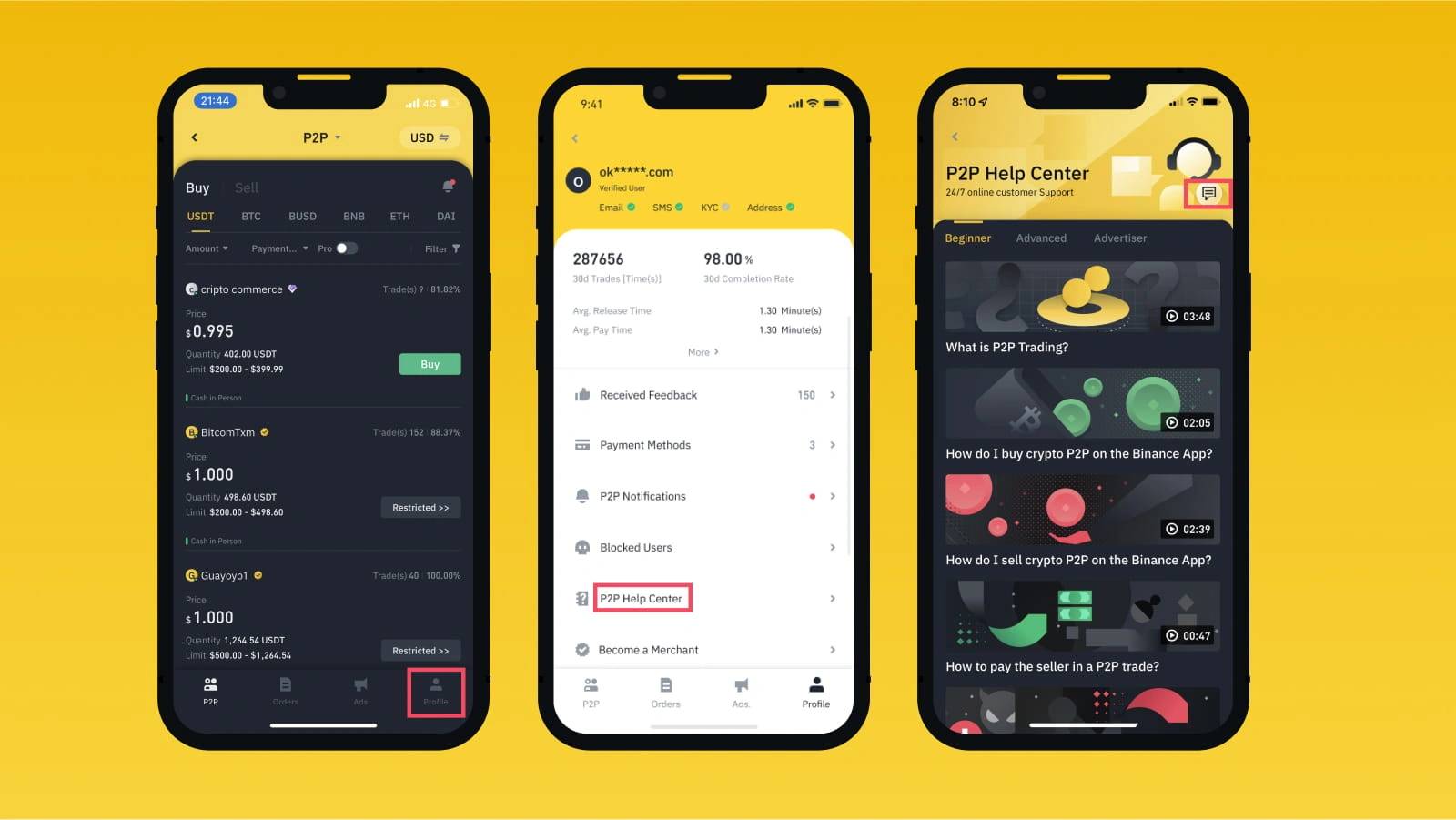
The platform includes a chat function for buyers and sellers to communicate during the transaction [1]. In cases of disputes, users can file an appeal. Binance provides customer support, including a live chat option and a comprehensive FAQ section, to assist in resolving issues [1] [4]. Users are advised to verify payment receipt independently before releasing cryptocurrency to avoid financial losses [1].
Trading Modes
Binance P2P offers several trading modes to cater to different user needs [5]:
- P2P: The standard marketplace where users can browse a list of buy and sell advertisements posted by other users and select their preferred counterparty.
- Express: A simplified interface for beginners that automatically matches a user with a counterparty for a quick transaction.
- Block Trade: A dedicated zone for high-volume transactions, allowing users to buy and sell large amounts of cryptocurrency securely [5].
Buying and Selling Process
To use Binance P2P, users must first register a Binance account and complete identity verification (KYC) [1]. The process for buying and selling involves several steps:
How to Buy Cryptocurrencies on Binance P2P
- Log in to the Binance account [1].
- Navigate to the P2P trading section, accessible from the homepage or under the 'Trade' section [1].
- Select the 'Buy' section and choose the desired cryptocurrency [1].
- Filter merchants by payment method and country/region if needed [1].
- Select a merchant based on their rate, terms, and reputation metrics like completion rate and user feedback [5].
- Enter the amount of fiat or crypto to trade and initiate the buy order [1].
- Proceed to the payment page to view the seller's payment information [1].
- Transfer the funds to the seller using the provided details within the given time limit (typically 15 minutes) [1].
- After transferring, click 'Transferred, notify seller' [1].
- Use the chat window to communicate with the seller and potentially provide proof of payment [1].
- Wait for the seller to confirm receipt of funds and release the cryptocurrency from escrow [1].
- The purchased crypto will be deposited into the user's Funding Wallet [1].
- To trade or use the crypto on other Binance services, it must be transferred from the Funding Wallet to the Spot Wallet [1].
How to Sell Cryptocurrencies on Binance P2P
- Log in to the Binance account and navigate to the P2P trading section [1].
- Select the 'Sell' section and choose the cryptocurrency to sell [1].
- Browse available buyers and select one offering a suitable rate and payment method, taking into account their reputation metrics [5].
- Enter the amount of crypto or fiat for the transaction and select a payment method to receive funds [1].
- Place the sell order [1]. The transaction status will show "Pending Buyer's Payment" [1].
- Communicate with the buyer via the chat window [1].
- Wait for the buyer to transfer the fiat payment [1].
- Crucially, log in to the receiving bank or wallet account to confirm that the payment has been received from the buyer [1]. Do not rely solely on screenshots or notifications [1].
- Once payment is confirmed as received, click 'Confirm receipt' and then 'Confirm' to release the cryptocurrency from escrow to the buyer's account [1].
- If payment is not received or issues arise, use the chat or the 'Appeal' function to contact customer service [1].
Advantages
Binance P2P offers several advantages for users trading cryptocurrencies [1].
- Fee Structure: Binance does not charge trading fees for takers who buy or sell using existing advertisements. Makers, who create advertisements, may be subject to fees that vary by cryptocurrency, though they may also incorporate a margin into their advertised price. Users may also receive discounts on trading fees by using Binance's native token, BNB [1] [4] [8].
- Multiple Payment Methods: The platform supports hundreds of payment options globally, including bank transfers, digital wallets, and numerous region-specific payment systems [1] [5] [8].
- High Liquidity: As an integrated part of the Binance ecosystem, which serves over 275 million users worldwide, the platform benefits from high trading volume, facilitating large buy and sell orders [1] [2].
- Global Adoption: The platform is a critical on-ramp and off-ramp for the crypto economy, especially in emerging markets. It is used as a hedge against inflation in countries with high currency devaluation, serves as an alternative channel for cross-border remittances, and provides a gateway to crypto in jurisdictions where banks are restricted from processing crypto-related transactions [8].
- Fast Transaction Speeds: Merchants can set transaction timers, with some trades completing within 15 minutes. The platform also displays an advertiser's average release time, giving users an indication of transaction speed [1] [5].
Security Features
Binance P2P incorporates several security measures to protect users during transactions.
- Escrow Service: To secure transactions for both parties, Binance holds the seller's cryptocurrency in an escrow service. The funds are locked when a trade is initiated and are only released to the buyer after the seller confirms that the fiat payment has been successfully received. This mitigates the risk of a seller accepting payment and not transferring the assets [1] [4].
- Identity Verification (KYC): All users trading on the P2P platform are required to complete identity verification, which adds a layer of security and compliance for all participants [5].
- Reputation System: User profiles display key metrics such as trading history, completion rate, and feedback from other traders, allowing participants to vet potential counterparties before initiating a trade [8].
- Verified Merchants: An additional layer of trust is provided through the Verified Merchant program, which grants a yellow badge to experienced, high-volume traders who undergo further vetting and meet stringent requirements [8].
- Dispute Resolution: In case of a disagreement, either party can file an appeal. Binance's support team reviews evidence (such as payment receipts) and mediates to ensure the crypto is released to the rightful party [8].
- Two-Factor Authentication (2FA): The platform supports 2FA as a standard security feature, adding an extra layer of protection to user accounts against unauthorized access [4].
Historical Milestones
- October 2019: Binance officially launches its P2P trading platform, initially supporting trades for BTC, ETH, and USDT against the Chinese Yuan (CNY) [8].
- 2020: The platform undergoes a major expansion, adding support for numerous fiat currencies and payment methods across Southeast Asia, Latin America, and Africa [8].
- 2021–2022: P2P volumes surge globally as the platform becomes a critical piece of infrastructure in emerging economies during the crypto bull run [8].
- March 2024: Amid intense regulatory pressure, Binance ceases all services related to the Nigerian Naira (NGN), delisting all NGN pairs from its P2P platform [8] [7].
Regulatory Scrutiny and Compliance
Binance, the parent company of the P2P platform, has faced significant regulatory scrutiny globally for enabling users to bypass formal financial systems [8].
In November 2023, Binance Holdings Limited reached a historic settlement with U.S. authorities, agreeing to pay over $4.3 billion to resolve investigations by the Department of Justice (DOJ), the Financial Crimes Enforcement Network (FinCEN), the Office of Foreign Assets Control (OFAC), and the Commodity Futures Trading Commission (CFTC). The investigations found that Binance had willfully failed to implement an effective Anti-Money Laundering (AML) program and lacked sufficient Know Your Customer (KYC) procedures. According to the U.S. Treasury, these failures allowed illicit actors to transact on the platform, facilitating activities related to sanctions evasion, terrorist financing, and darknet markets. As part of the settlement, Binance's founder and then-CEO, Changpeng Zhao, pleaded guilty to violating the Bank Secrecy Act (BSA) and resigned. The company is now subject to a five-year independent compliance monitorship and must undertake a complete exit from the United States [3].
Binance has faced regulatory challenges in other regions as well:
- Nigeria: In early 2024, the platform faced a crackdown from Nigerian authorities, who accused it of facilitating currency speculation and contributing to the devaluation of the Naira [6]. The situation escalated with the detention of two Binance executives and charges related to tax evasion and foreign exchange manipulation. In response, Binance removed the Nigerian Naira (NGN) from its P2P service in March 2024, ceasing all NGN-related trading pairs [7] [6].
- Pakistan: Pakistan's Federal Investigation Agency (FIA) launched an investigation into a cryptocurrency scam valued at over $100 million that affected more than 100,000 citizens. The fraud involved fake online investment apps that used Binance blockchain addresses for transactions. The FIA contacted Binance, which nominated officials to cooperate with the investigation [9].
- India: Authorities in India have investigated the use of Binance P2P for money laundering and other illicit activities [8].
Risks and Vulnerabilities
The U.S. Treasury's 2024 National Money Laundering Risk Assessment highlighted that P2P payment systems, including those transacting in virtual currency, are increasingly used by criminals for fraud and other illicit activities. While the report did not specifically name Binance P2P, it identified the sector as a significant vulnerability for money laundering due to the speed and direct nature of transactions [3].
Common fraud typologies on P2P platforms include:
- Seller Scams: A scammer poses as a legitimate seller, receives a P2P payment for goods or services, and then fails to deliver the product.
- Money Mule Scams: Scammers use unwitting individuals (mules) to move illicit funds. This can involve sending money from a stolen source to a victim's account and instructing them to forward it, or making an "accidental" transfer and asking for the funds to be returned. In both cases, the initial fraudulent transaction is eventually reversed, leaving the victim liable for the money they sent [3].
- Social Engineering Scams: Users can be convinced to release crypto from escrow before payment has been properly verified in their own bank or e-wallet account, or they may be tricked by fraudulent payment receipts [8].
The report also noted that virtual asset P2P platforms face specific compliance challenges. These include the risk of disintermediation, where transactions occur directly between users' unhosted wallets without a regulated intermediary, and regulatory arbitrage, where illicit actors exploit platforms in jurisdictions with weak AML/CFT controls [3].
Comparison with Remitano P2P
Binance P2P is often compared to other peer-to-peer trading platforms like Remitano [1]. Both platforms facilitate P2P cryptocurrency trading, but they have differences in features and fee structures [1].
| Criteria | Binance P2P | Remitano |
|---|---|---|
| Credibility | Both are described as prestigious P2P exchanges with over 5 years of operation in the international market . | Both are described as prestigious P2P exchanges with over 5 years of operation in the international market . |
| Transaction Fees | Free for buyers and sellers using existing ads; fees apply for active merchants creating ads. withdrawals are free . | Buyers may pay approximately 1% higher than the display price. A 1% fee is collected when withdrawing from a wallet . |
| Convenience | Integrated within the ecosystem, convenient for trading on spot markets. The broader platform supports over 350 listed cryptocurrencies . | Primarily supports around 20 coins . |
| Remitano is noted as popular in the United States, Vietnam, China, and South Asian countries . |
Instructions for Trading Coins
For information on spot trading on Binance, users can refer to guides on that specific topic [1].
Image: Illustration depicting Binance P2P as a peer-to-peer cryptocurrency trading platform [1].
잘못된 내용이 있나요?