# Tars AI
> Tars AI is an AI-focused ecosystem on Solana, offering modular AI tools and products, and featuring the TAI token.
- Canonical URL: https://dev.iq.wiki/wiki/tars-ai
- Categories: Projects & Protocols
- Tags: AI Token, Infrastructure
- Created: 2025-03-05T02:47:02.328Z
- Last updated: 2025-03-05T03:05:00.506Z
- Source: IQ.wiki — the world's largest blockchain and crypto encyclopedia (https://iq.wiki)
---
**Tars AI** is an artificial intelligence platform that integrates machine learning frameworks with decentralized [blockchain](https://iq.wiki/wiki/blockchain) infrastructure. Launched in 2023 by Tars Protocol, the platform focuses on enabling privacy-preserving AI model training, decentralized computational resources, and community-driven governance. Its ecosystem is designed to support interoperability and scalability while providing access to AI development tools. [[1]](#cite-id-FIaYeL9HhV) [[2]](#cite-id-GTcyiG7Wmm)
# **Overview**
Tars AI functions as a multi-layered network connecting AI developers, data providers, and computational resource contributors. The platform is structured around three primary components:
1. **Tars Hub**: A [decentralized autonomous organization](https://iq.wiki/wiki/dao) (DAO) responsible for managing protocol upgrades, treasury allocations, and community proposals.2. **Tars Builder**: A set of tools for creating and deploying AI models on-chain, offering templates for applications such as natural language processing (NLP) and computer vision.3. **Decentralized Compute Network**: A global network of [nodes](https://iq.wiki/wiki/node) that provide computational resources (GPUs/TPUs) for AI model training, incentivized through the platform’s native token, TAI.
The platform incorporates [zero-knowledge proofs](https://iq.wiki/wiki/zero-knowledge-proofs-zkps) (zk-SNARKs) for data privacy, supports cross-chain compatibility with [Ethereum](https://iq.wiki/wiki/ethereum) and [BNB Chain](https://iq.wiki/wiki/binance-smart-chain), and implements a tokenized rewards system for participants.
# **History**
Tars AI was established in 2023 by a team of AI researchers and [blockchain](https://iq.wiki/wiki/blockchain) developers. The project emerged during a period of growing interest in decentralized technologies and their potential applications in artificial intelligence. Initial funding was secured through a combination of venture capital investments and decentralized grants, enabling the team to outline its vision in a manifesto that emphasized the decentralization of AI infrastructure. [[2]](#cite-id-GTcyiG7Wmm) [[1]](#cite-id-FIaYeL9HhV) [[3]](#cite-id-6UblVOgqcH)
# **Technology**
Tars AI’s technical framework is built on four key components:
1. **Privacy-Preserving Computation**: Employs [zk-SNARKs](https://iq.wiki/wiki/zk-snark) and homomorphic encryption to enable model training on encrypted datasets, ensuring data confidentiality.2. **Decentralized Compute Marketplace**: A network of [nodes](https://iq.wiki/wiki/node) contributes hardware resources, with a [consensus mechanism](https://iq.wiki/wiki/consensus-mechanism) optimized for AI tasks and resource allocation managed by a proprietary algorithm.3. **Interoperability**: Facilitates AI model portability across [EVM](https://iq.wiki/wiki/ethereum-virtual-machine-evm)-compatible [blockchains](https://iq.wiki/wiki/blockchain) and integrates with [IPFS](https://iq.wiki/wiki/ipfs) for decentralized storage.4. **Open-Source SDKs**: Provides libraries for model quantization, on-chain inference, and token-gated access to datasets.
The platform uses a consensus mechanism called "Proof-of-Learning," which evaluates contributions based on the quality of computational output rather than raw power, aiming to reduce energy consumption. [[1]](#cite-id-FIaYeL9HhV) [[2]](#cite-id-GTcyiG7Wmm) [[3]](#cite-id-6UblVOgqcH)
## **TAI Token**
The TAI token, based on the [BEP-20](https://iq.wiki/wiki/bep-20) standard, serves as the platform’s [utility](https://iq.wiki/wiki/utility-token) and [governance token](https://iq.wiki/wiki/governance-tokens), with a maximum supply of 1 billion tokens.
**Functions**:
- **Network Fees**: TAI is used to pay for computational resources and model deployment.- **Staking**: Node operators and [validators](https://iq.wiki/wiki/validator) [stake](https://iq.wiki/wiki/staking) TAI to participate in network security and receive rewards.- **Governance**: Token holders can vote on DAO proposals, including treasury allocations and protocol upgrades.
# **Tokenomics**
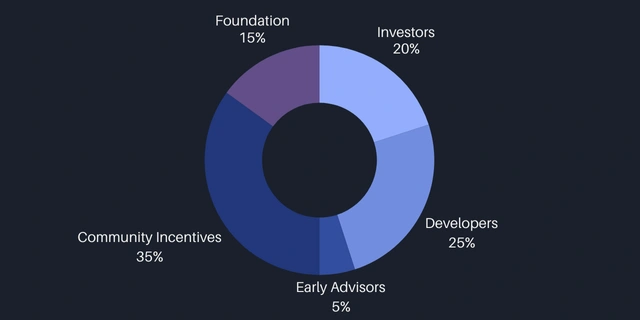
- 35% allocated to community incentives, 25% to developers, 20% to investors, 15% to the foundation, and 5% to early advisors.
Tars AI collaborates with decentralized storage networks like [Filecoin](https://iq.wiki/wiki/filecoin) and [Arweave](https://iq.wiki/wiki/arweave) for dataset hosting. It also works with [DePIN](https://iq.wiki/wiki/depin) projects to expand its node network. The platform’s grant program supports research in areas such as ethical AI auditing and low-resource language models. [[4]](#cite-id-IH4iyBpBA5) [[5]](#cite-id-vm94z7WdjU) [[2]](#cite-id-GTcyiG7Wmm) [[1]](#cite-id-FIaYeL9HhV) [[6]](#cite-id-mxogY06wnm) [[7]](#cite-id-wf3Mr9VQyK)